Periods of Solidarity and Renewal: When Funders Invest in the Full Arc of Leadership Transitions
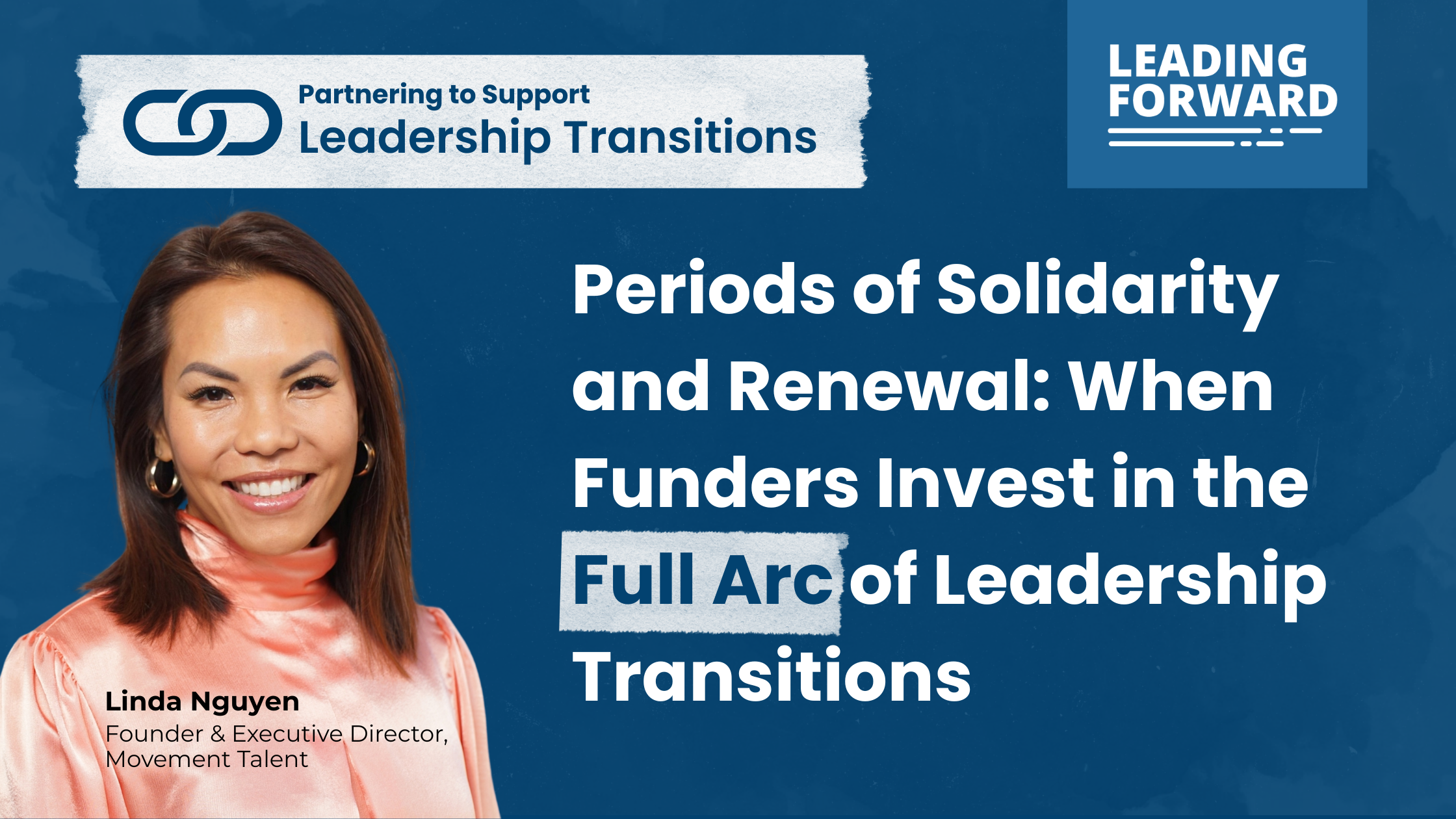
By: Linda Nguyen , Founder and Executive Director, Movement Talent
When an Executive Director transition begins, the most visible moment is often the search. But the success of that search, and of the leader who follows, depends on a much broader set of conditions, including organizational sustainability, staff morale, succession planning, and boards' readiness to lead the work ahead.
At Movement Talent, we’ve seen firsthand how funders can play a decisive role in shaping those conditions through our work supporting a dozen ED/CEO searches over the last five years. At a time when many organizations are navigating funding uncertainty, leadership turnover, and increased demand for their work, funder partnerships during transitions have made the difference between straining organizations and strengthening them.
While the need for more resources is ever real, we’ve also seen encouraging examples of how funders are already stepping in—and how their approach can serve as a model for others.
Funding the Full Arc of Transition
One of the most impactful shifts we’ve seen is when funders recognize that search is just one part of a transition.
In several cases, funders have supported not only the recruitment effort, but also the work that happens before and after a hire: helping organizations reflect on what they need in their next leader, supporting interim leadership and existing staff, or creating space for coaching, onboarding, and alignment once a new Executive Director is in place.
This kind of support allows organizations to move with intention rather than urgency. It also reduces the likelihood that new leaders will inherit unresolved challenges without the context or support to address them. For example, one of our partner organizations in the Pacific Northwest saw a major funder provide additional funding for the ED transition, and also served as a mentor to the board chair as they navigated challenging transition dynamics.
Bridging the Gap Between Need and Ability to Pay
Many of the organizations Movement Talent works with are navigating real financial constraints, even as they face critical leadership moments.
We’ve partnered with funders who understand this tension and have helped bridge the gap between what organizations can afford and what strong transitions require. In practice, this has meant flexible funding that allows organizations to access search and transition support without compromising on quality.
Movement Talent’s “pay what you can” approach (anchored in the support we receive from foundations) has enabled community-based organizations doing critical work to engage in thoughtful, well-supported search processes. We also partner with movement organizations in other ways to bolster that funding, including writing grant proposals to support them in hiring external help, such as interim EDs, transition specialists, etc., and to stabilize organizations where the departing ED was the chief fundraiser.
Allowing for Flexibility in Uncertain Contexts
Another welcome pattern we’ve seen is when funders recognize that transitions don’t always unfold predictably. Searches may shift. Timelines may extend. In some cases, organizations may need to pause or rethink a hire altogether.
Funders who build in flexibility – through adaptable timelines, openness to evolving scopes of work, and trust-based communication – help create the conditions for better long-term outcomes. Rather than reinforcing pressure to fill a seat quickly, this patient approach supports organizations in making sound decisions, even when circumstances change. For example, we saw how funders’ patience and partnership stance supported a community-based organization in NYC whose leadership transition timeline extended by a year beyond what was originally forecast. In this instance, funders offered additional bridge funding and welcomed conversations with new leaders once they were in place.
Investing in People, Not Just Positions
In the current landscape, leadership transitions are not only affecting organizations—they are affecting the people doing the work. We are seeing an increasing number of experienced leaders seeking guidance and support as they navigate layoffs, organizational closures, burnout, and career transitions. Some funders have recognized this broader ecosystem need and supported efforts that provide career guidance, coaching, and connection for individuals—not just hiring support for organizations. A number of training institutes, such as Leadership for Democracy and Social Justice, feature these services for movement leaders. Movement Talent has partnered with LDSJ and others to supplement their offerings and would like to scale this work in the future.
This kind of investment helps retain talent within the movement sector and ensures that leadership transitions do not have to result in a loss of hard-earned knowledge and experience.
Seeing What’s Possible
Across these examples, a consistent pattern emerges: when leadership transitions are resourced as moments of reflection, alignment, and care — not just hiring — organizations move through them differently. They ask better questions. They make more grounded decisions. They create stronger conditions for incoming leaders to succeed.
We have seen this happen even in a constrained funding environment. With the right kind of funder partnership, by funding the full transition arc, bridging the cost of recruitment, and demonstrating patience, transitions that might otherwise feel rushed or destabilizing can instead become periods of solidarity and renewal.
BIO
Linda Nguyen is the founder of Movement Talent, launched in 2020 to strengthen how U.S. social movements identify, develop, and support talent. Her experience spans leading recruitment and staff development at Community Change, building civic engagement capacity across a national network of 500 frontline human service organizations, and serving on boards focused on democracy, government accountability, and women’s rights.