When the Village Shows Up: Rethinking How Philanthropy Supports Transitions
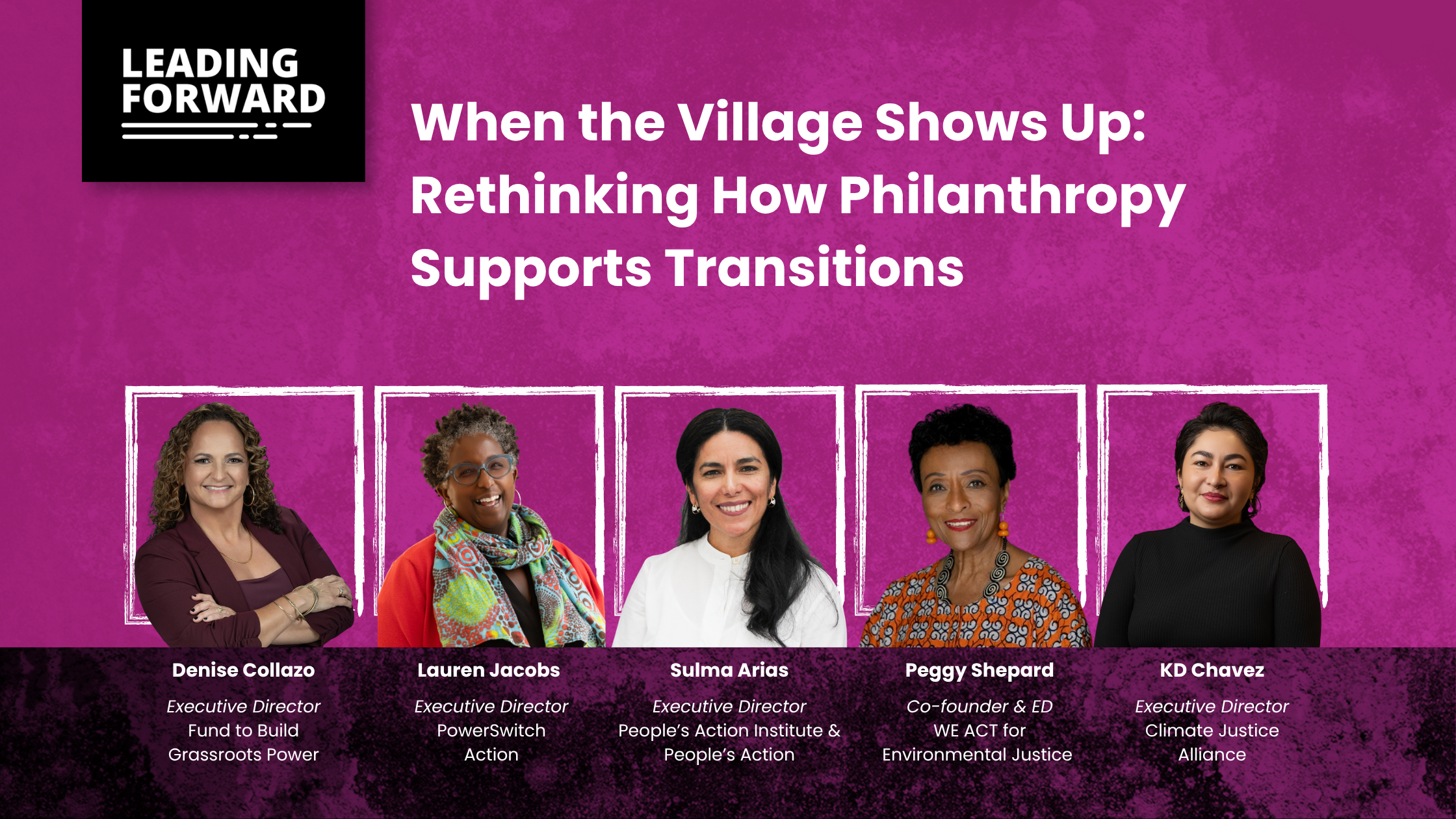
By Sulma Arias, KD Chavez, Denise Collazo, Lauren Jacobs, and Peggy Shepard
When a baby is on the way, families and friends don’t wait and see. They show up early with support, casseroles, and care. We know that transitions – like birth, loss, change and renewal of any kind – are when people and communities most need to be held.
Philanthropy needs to learn this lesson. Funders know how to support programs, but not organizational and leadership transitions. And right now, our movements are full of them.
The 185 organizations across the four national networks that comprise the Fund to Build Grassroots Power are telling us that they're in a moment that holds both tremendous opportunity and real risk. Climate crises are escalating. Political attacks are intensifying. And many of the BIPOC women and gender-expansive leaders who built the environmental justice movement are reaching retirement age. Each time we lose an executive leader to exhaustion, illness, or harm, we lose knowledge that our movement needs for decades to come.
This is not a benign oversight on philanthropy's part. It is a strategic choice — to fund programs over people, deliverables over continuity, the next campaign over the leader who will carry it. That choice is actively harming social justice movements. Transitions get treated as administrative line items, not as the transformative periods they actually are. That calls for an ecosystem and nimble response from funders.
Through the Fund to Build Grassroots Power, we're shifting how we show up for our movement leaders and organizations in an intentional way to sustain our communities.
1. We're changing the way we share money.
The Fund to Build Grassroots Power, comprised of four national networks – Climate Justice Alliance, Environmental Justice Leadership Forum,People’s Action Institute, and PowerSwitch Action, was launched eight years ago, in partnership with the JPB Foundation (now Freedom Together Foundation). Since then, we've moved $34 million to grassroots, frontline organizations in 43 states and two U.S. territories. The Fund is now evolving from a funder-grantee experiment into movement-owned infrastructure driven by movement needs.
In response to what our movement organizations are facing, this year we changed how we share money with them, moving 35% of our grantmaking budget towards discretionary needs. These include:
urgent crises or imminent opportunities including leadership transitions, and
healing justice needs — where a small amount of money goes a long way toward rest, renewal, repair, or resolving rupture.
The shift other funders can make: Build a quarterly discretionary pool, even a small one, that you can release without a full proposal cycle. Transitions don't wait for your board meetings and emergency needs require prompt resourcing.
2. We're making it easy to ask for money.
For our Spring grantmaking cycle, we moved from an invitation-only application round, to an open community-wide request for information via the JustFund platform. The request for information had one question, a few checkboxes, and an optional attachment. The response was overwhelming — more than half of our membership applied.
While the response was surprising, we learned something critical from the request for information: the largest category of need was organizational transitions — leadership changes, founders stepping down, restructures designed to advance equity, unexpected staff losses, and temporary funding cliffs. Funders rarely support executive transitions. So we did. We directed 48% of our spring grantmaking to 24 organizations navigating transitions such as funding succession planning, staff retreats, time for renewal, and health needs of directors who pour themselves into community while often neglecting their own well-being.
One of them was a grassroots organization in the Pacific Northwest focusing on food justice, workers rights, and sustainability. The organization requested funding to support a critical leadership transition as its founder prepares to step down after more than 30 years leading farmworker organizing in the state. A $12,000 rapid-response grant — modest by foundation standards — will support succession planning, staff training, and ensure continuity of cooperative farm initiatives, immigrant and farm worker organizing during a time of increasing threat, aggressive pushback from big agriculture, and racist targeting by ICE of their leadership. That is what showing up at a transition looks like. It is recognizing that the people and infrastructure carrying a movement are worth funding as much as the programs they run.
The shift other funders can make: Simplify your application. A one-question form surfaced the needs that we would never have seen through an invitation-only process. Make transition support an explicit, named category in your grantmaking — not an exception you grudgingly accommodate. And fund the leader, not just the program. Succession planning, sabbaticals, medical leave coverage, and staff retreats are not overhead. Additionally, fund the new and younger leadership stepping up to carry the mission forward. They are the movement.
Families and communities know that transitions are when you show up hardest, not when you wait to see how things turn out. Communities know it. Philanthropy needs to learn it now, while the leaders who built this movement are still here to hand off what they know.
So here is the ask. If you are a program officer: make transition support a line in your next docket. If you are a foundation leader: create a discretionary pool you can move in weeks, not quarters. If you fund movements at all: ask your grantees what transitions they are navigating right now, and trust their answer about what they need. The village is already showing up. The question is whether those of us in philanthropy will show up with it.
Sulma Arias brings over 20 years of organizing experience to her role as Executive Director for People’s Action Institute and People’s Action. Sulma’s organizing work spans many issues, including immigrant rights, voting rights, and economic justice, and her practice has always centered directly impacted people to build power.
KD Chavez serves as the Executive Director of the Climate Justice Alliance, representing a growing member alliance of nearly 100 urban and rural frontline communities, organizations, and supporting networks in the climate justice movement. With over a decade in social justice nonprofit leadership, they have mobilized people and resources to drive transformative change, inspiring collective action through cultural transformation, strategic investment, and regenerative, community-rooted models.
Denise Collazo is Executive Director of the Fund to Build Grassroots Power, a movement-accountable intermediary fund that practices participatory democracy by engaging the leadership and members of four national networks. Denise is known as a leader in the U.S. social justice movement, having spent 30 years building grassroots community organizations at the local, regional, state, and national levels.
Lauren Jacobs is the executive director of PowerSwitch Action, a national network of local powerbuilding organizations that weave together community, labor, faith, racial justice, and environmental justice movements into powerful coalitions. She has dedicated her life to supporting working people as they gain power to shape their own working and living conditions. Lauren has organized with textile, janitorial, security, and restaurant workers at UNITE, SEIU, and the Restaurant Opportunities Centers United.
Peggy Shepard is co-founder and executive director of WE ACT for Environmental Justice which hosts the Environmental Justice Leadership Forum. She has successfully combined grassroots organizing, environmental advocacy, and environmental health community-based participatory research to become a national leader in advancing environmental policy and the perspective of environmental justice in urban communities — to ensure that the right to a clean, healthy, and sustainable environment extends to all.