Building Trust Before the Transition: What Funders Can Do Differently
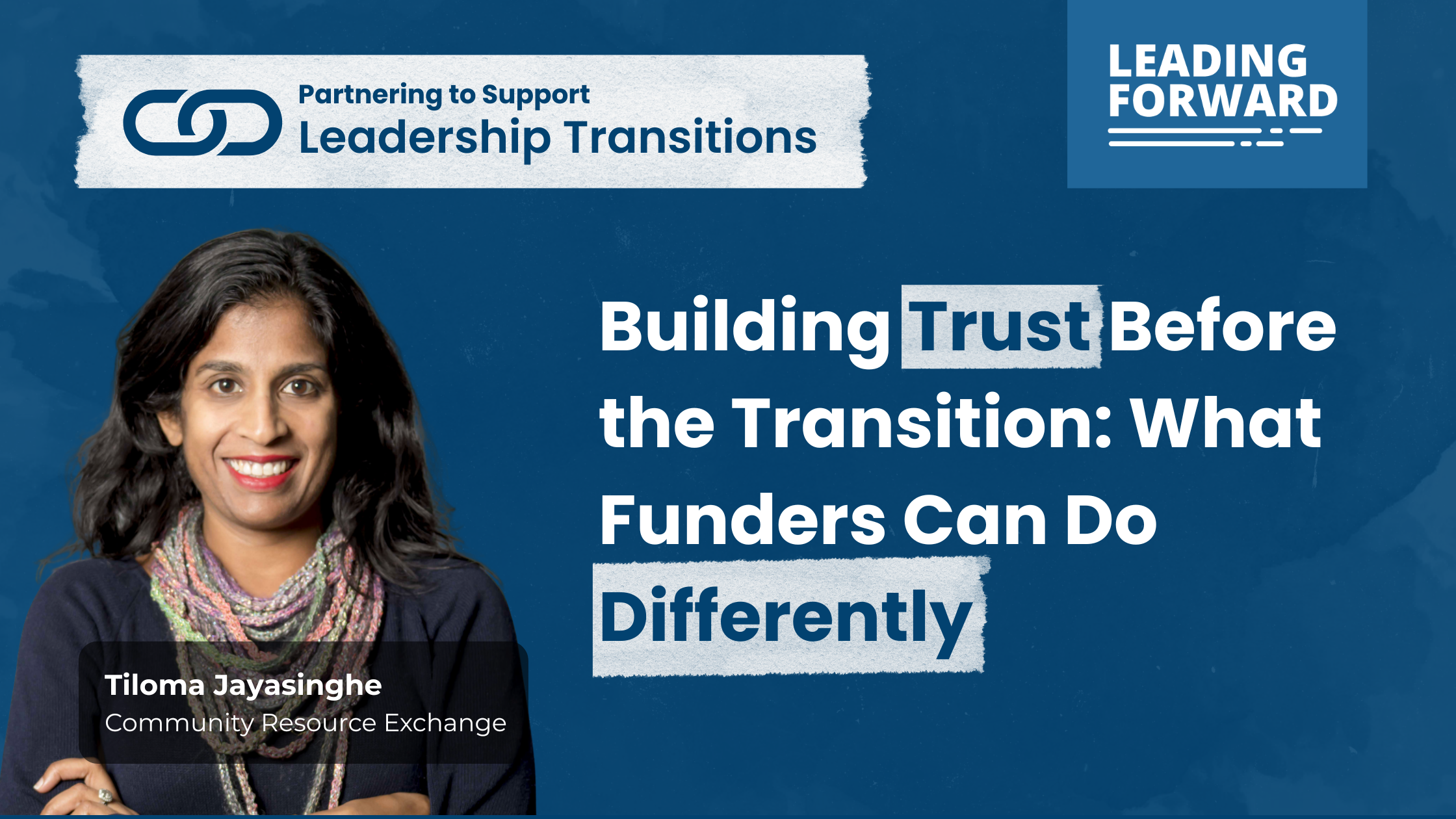
By: Tiloma Jayasinghe , President and CEO, Community Resources
Funders are often the last ones to know about a leadership transition. Sometimes it's only when the new executive reaches out to introduce themselves that a funder might learn of a leadership transition. Rather than being thought of as an ally, an investor, a stakeholder, funders are often perceived as threats.
Nonprofits fear that revealing succession plans early will jeopardize future funding — a perception reinforced by years of funders “waiting and seeing” during a transition. They worry that organizational reputation will suffer, the transition will be perceived as “a disruption,” and the funder will pull back. However, leadership transitions are a normal and healthy “changing of the guard” that is actually beneficial for that organization’s sustainability.
Contrast this with what successful transitions actually require: time, investment, and wraparound support. With a long enough runway and the right resources, disruption can be minimized, continuity preserved, and leaders transitioning in and out with care. This is what we’ve learned from years of supporting leadership transitions at Community Resource Exchange (CRE).
But that’s rarely what we see in real life. At CRE, where we support nonprofits to build sustainable strategies and grow with change, we’re often brought in after an executive has already given notice. At that point, the clock is ticking and internal and external pressures often compress what should be a thoughtful process into a race against time.
Where is this coming from? A strong taboo still exists in the nonprofit sector, around sharing an imminent leadership change. It’s not just institutional funders who are perceived as threats. Boards, staff and other partners are often also informed late, accompanied by worries that they will lose confidence prematurely in the outgoing leader.
If we want to disrupt this pattern and conditioning, funders need to change the narrative.
Beyond focusing on how funders can respond once a transition is announced, they must also create conditions where nonprofit leaders feel safe sharing their thinking much earlier. If you have deep, continued, and longstanding relationships with your grantees, then you will have built enough safety to hear when they are contemplating a transition. A funder who listens well and responds without judgment can become someone a nonprofit leader confides in early, rather than the last person to hear the news.
We’ve seen the power of this approach firsthand.
In one instance, a funder noticed an unusual number of messages about leadership transitions among her grantees over the course of a single summer. Rather than treating this as a series of isolated events, she recognized a broader pattern, the generational shift from founding leaders, and the impact it can have on the ecosystem.
Instead of limiting support only to her own grantees, she partnered with CRE to support a cohort of founders across the sector while also convening leaders to share lessons and develop resources for future transitions. It’s an expansive approach that pairs individual support with field-building knowledge.
Another funder, who had built real, caring relationships for decades with a small cohort of organizations serving a thematic close-knit community, could see that many were still led by their founders. These leaders trusted her enough to share when succession planning on the horizon. She invited those organizations to work with CRE on transition planning well before announcements or forced timelines.
These approaches are deeply relational. The goal isn’t simply to ensure organizational continuity; it’s also to care for the outgoing leader, support the incoming one, and help the organization navigate change with stability and confidence.
In both instances, the differentiator wasn’t the strategy—it was the posture. These funders weren’t waiting to be informed; they were building the kind of trust so that leaders could be vulnerable and share early. That requires a funder shift from oversight to partnership, from risk aversion to relational investment. The outcomes of this shift? They normalize the role of philanthropy in supporting and resourcing leadership transitions, and they acknowledge that resourcing this work leads to less disruption and more positive impact. The anecdotes I shared above point to a few practical shifts funders can make:
Normalize early conversations about leadership transition. Signal clearly that discussing succession planning will not jeopardize funding. This can show up in small but meaningful ways: building a simple non-judgemental check-in question into regular conversations (“What’s on the horizon for your leadership?”), sharing how you’ve supported other transitions across your portfolio, or even putting a point of view in writing so grantees know you see leadership change as a natural—and supportable—part of organizational life. Some foundations, such as Cricket Island, Hewlett, Durfee and Barr, and pooled funds such as Nonprofit Sustainability Initiative in Los Angeles, set aside transition-specific funds, making it clear that planning ahead is something to be resourced, not avoided.
Invest in transition support as a form of capacity building. Leadership change is predictable and inevitable; resourcing it reduces disruption.
Listen deeply and consistently. When funders practice curiosity and trust, leaders are more likely to share emerging challenges early.
Support both organizations and the broader field. Funding transition work at the sector level helps build shared tools and knowledge.
Leadership transitions are not rare events. They are a defining feature of the nonprofit sector right now. If philanthropy wants organizations to navigate them well, funders must move beyond reacting to transitions and instead help create the conditions that make thoughtful planning possible. The call to action for funders is simple but powerful: build the kind of trust with your grantees that allows leaders to tell you they are thinking about leaving long before they have to. When that happens, leadership transitions stop being crises to manage and become opportunities to strengthen organizations for the next chapter.
BIO
Tiloma Jayasinghe is the President & CEO of Community Resource Exchange (CRE), a nonprofit consulting firm that has partnered with thousands of community organizations over its 45-year history. A movement-builder and champion of the nonprofit sector, she has led and supported organizations advancing reproductive rights, racial justice, and gender equity locally, nationally, and globally. Her leadership roles include Executive Director of Sakhi for South Asian Women, Social Affairs Officer at the United Nations, and Chief Program Officer at Nonprofit New York. She lives in New York with her husband and two teenage daughters who are unimpressed with her bio.