Leadership Transitions as Ecosystem Opportunities
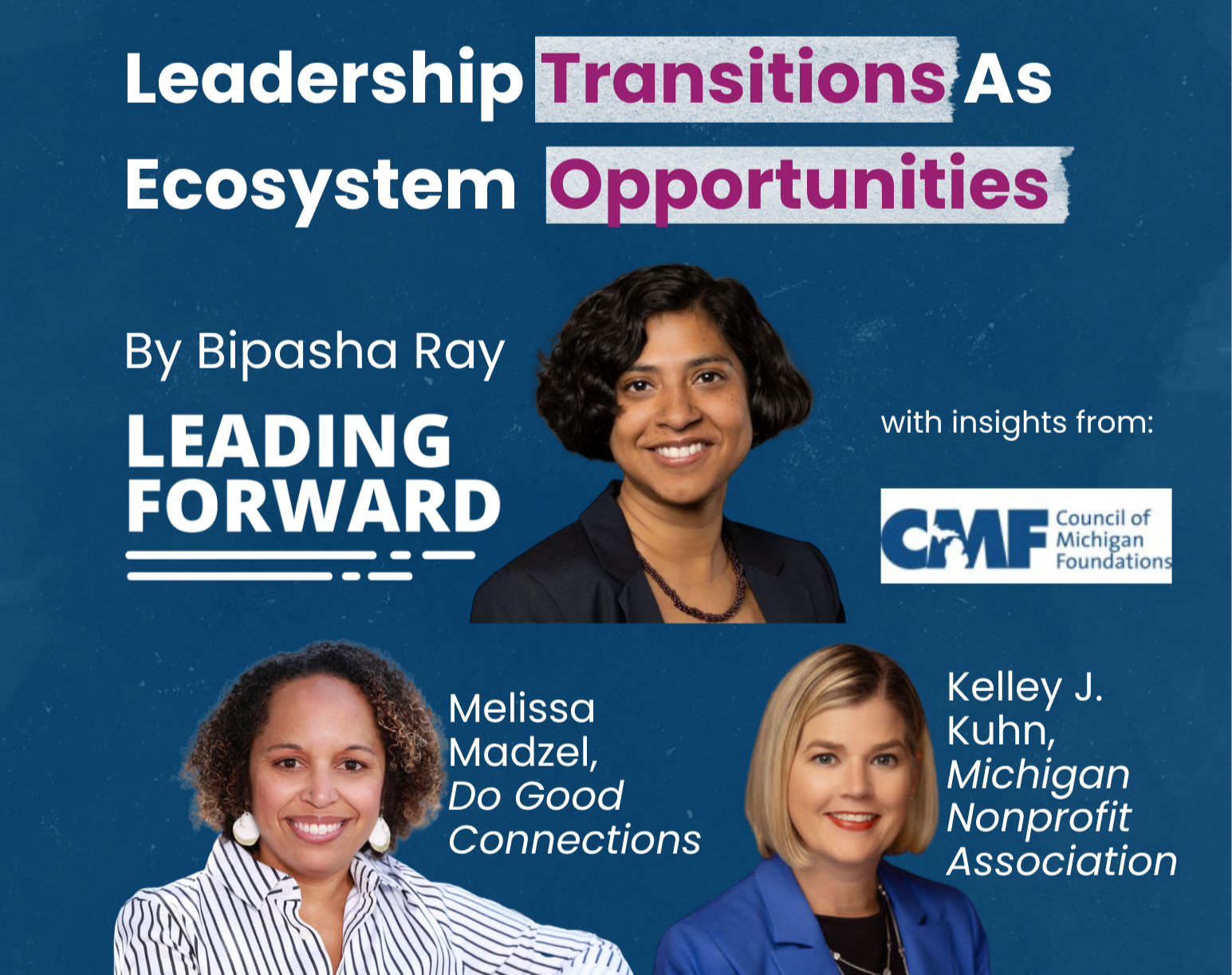
By Bipasha Ray, Leading Forward
First published on the Council of Michigan Foundations website. Reprinted with permission. Original Link: https://www.michiganfoundations.org/news/leadership-transitions-ecosystem-opportunities
Nonprofit leadership transitions are often seen as times of increased risk, but they can actually be profound periods for ecosystem collaboration. In the current climate of social and political upheaval, when communities are experiencing deep stress and heightened needs, that collaboration – especially between funders and the nonprofits they support – is needed more than ever.
This was one of the takeaways from a recent webinar hosted by the Council of Michigan Foundations (CMF), “Stewarding Change: The Role of Foundations in Leading and Supporting Values-Driven Executive Transitions.” It was presented in collaboration with my organization, Leading Forward, a funder community advocating for better support of executive leadership transitions and succession planning. (The recording is available to CMF members in CMF’s online Knowledge Center.) This webinar explored how values-aligned leadership transitions at foundations can be an entry point for equitable partnership with grantees also undergoing executive transitions. While these periods can be deeply vulnerable, they also present meaningful opportunities to deepen support for organizational growth, rejuvenation and ecosystem transformation.
Critical Junctures for Ecosystem Collaboration and Organizational Renewal
Nonprofit leadership transitions are surging, as leaders face funding cutbacks, extensive burnout, rising insecurity and needs among their communities, and the entire social sector is facing scrutiny and uncertainty at the federal level. A recent Center for Effective Philanthropy report showed that more than half of surveyed nonprofit executive directors (EDs) were leading in an atmosphere of increased fear and stress, and the burnout of EDs as a significant concern jumped from 29% to 46% in just one year. Additionally, almost 60% of respondents said foundation grants are harder to secure, and more than a third of surveyed organizations indicated they are facing budget deficits.
Today’s nonprofit leaders are “carrying a double burden” – struggling with the sustainability of their own leadership and organizations, while also managing the increased stress and needs of the communities they serve in a polarized climate, said Kelley Kuhn, president and CEO of the Michigan Nonprofit Association. This is compounded by external stressors, including federal funding cuts, state budget negotiations, and election-year uncertainty.
In these times, it is critical for nonprofits and funders to work in partnership, especially during vulnerable periods like leadership transitions. Collaboration is “a strategy for helping us move through so much chaos, so much uncertainty,” Kuhn said. “In this moment, it is about coming together for the broader ecosystem for systems-level change. The only way we’re going to navigate this is that we stay unified.”
Transitions bring in renewed leadership energy and capacity to strengthen the ecosystem. “With new leadership comes new ideas and fresh perspectives and an opportunity to grow and strengthen internal and external relationships and processes,” said Kyle Caldwell, president and CEO of CMF.
Transitions are also a time for organizations to re-assess their effectiveness, including the chance to realign internal structures with external demands, said Kuhn. While search processes might be seen as a “burden,” Caldwell suggests they are actually a “privilege and a growth opportunity.” Transitions allow organizations to evaluate their lifecycle stage and ensure they have the “right people in the right seats at the right time.” With robust resourcing and support, leaders can engage in honest reflection and make changes, so that transitions become periods of organizational transformation.
How Funders Can Lead the Way to Partnership
Foundations themselves are seeing significant levels of leadership transitions around the country. Historically, some foundation leadership transitions have led to funding disruptions, as they might pause grantmaking for extended periods to engage in internal strategic planning. However, funders can use their own transitions and organizational renewals to gain a unique values-driven perspective on the importance of partnerships with grantees and keeping operations stable at such times.
A values-aligned transition isn't just about hiring a new leader; it’s about understanding that transitions impact the staff, the board, the departing leader, and the candidates, as well as the community, according to Melissa Madzel, founder and principal of Do Good Connections, which specializes in people-centered board recruitment and executive searches. Values-aligned searches “understand all of these various constituents, and that they have different needs, and work to attend to those needs.”
To ensure that nonprofits also have the space and resources for values-aligned transitions, funders can help by recognizing and helping to resource the “hidden costs” of transitions, both tactical and emotional – values-aligned search firms, transition consultants to manage organizational relationships, board and staff retreats to process the complex emotions of transitions, and legal counsel to help develop equitable contracts for incoming leaders and separation agreements to honor outgoing leaders, according to Madzel. Additionally, funders can resource and encourage interim leadership to pave the way during leadership transitions and guide and prepare board and staff for a new leader, Kuhn shared.
A Call to Courageous Action
To turn the “wave of change” that nonprofits are experiencing in Michigan and across the country into an opportunity to build resilience, the webinar highlighted a call to funders to lean into supporting values-aligned leadership transitions.
Center people: Funders must shift their perspective to “center the organization, center the people... and de-center yourself as the funder,” said Madzel. Rather than worrying about what a grantee transition means for the funder’s own grant portfolio, Madzel recommended asking: “What does this mean for the humans who do this work every single day, and how can I provide resources... to make sure that this transition happens effectively?”
Collaborate as an ecosystem: Recognizing that funders and the organizations they fund are all part of the same ecosystem, transitions offer a chance for deep values-aligned support and partnership. Additionally, funders themselves can organize their peers and leverage the philanthropic ecosystem to support common grantees through pooling and resource sharing. It is also critical to communicate clearly what funding is available so that organizations in transition can plan effectively. Leading Forward’s Action Guide for Funders offers a toolkit with sample practices and linked resources to illustrate the range of ways funders can collaborate with each other and their grantees during transitions.
Assume Trust: When a new leader takes over, assume trust in both the organization’s choice and the new leader themselves. Avoid the “wait and see” practice, which can be particularly hurtful to leaders of color, and undermines the very organizational mission that funders have been investing in.
Normalize Succession: Succession planning should be seen as a standard aspect of organizational culture rather than a reactive crisis. “The best time to talk about succession planning is when the new person is hired,” Caldwell said. “When we don't normalize a change process, all the ‘isms’ – founder syndrome, groupthink, boards that don't see the future – happen.” Funders can normalize this by modeling their own comfort with change and succession planning and providing funding to build internal talent and develop a bench of leaders.
Stepping up to nonprofit executive leadership in these times is an act of courage. Periods of leadership transition allow “the ecosystem itself to be courageous,” Kuhn said. We invite funders to mirror that courage by providing bold, values-aligned support to their grantee partners, turning the vulnerability of transitions into growth and rejuvenation.
Want more?
Learn more about Leading Forward.
Bio:
Bipasha Ray– Leading Forward, Project Lead
Bipasha Ray is a human rights and social justice advocate with a passion for supporting the resilience and capacity of activists and movements working towards a more just and equitable society. She enjoys working with equity-minded philanthropies and nonprofits to design human-centered leadership and organizational development and fellowship programs. She has a particular interest in sustainable leadership transition support after running and learning from the New Executives Fund at the Open Society Foundations. Bipasha combines nearly 20 years of experience in political philanthropy, fiscal sponsorships, human rights, journalism, and policy research at Panorama Global, the Open Society Foundations, and The Associated Press.