
By Bipasha Ray, Project Lead, Leading Forward
While leadership transitions are vulnerable periods for any organization, they are particularly momentous at fiscal sponsors which steward billions of dollars, and can have ripple effects across entire ecosystems.
However, community-aligned fiscal sponsorship isn’t only the movement of money and provision of administrative infrastructure; the relationships between funder, sponsor, community, and projects are the infrastructure. When those movement hubs and incubators hold pooled financial assets, legal risk, and operational and relational infrastructure for dozens or hundreds of independent people and projects, leadership transitions can be deeply vulnerable but also critical periods of rejuvenation and renewal for entire ecosystems. And guiding values and principles can be the anchors that ground transitions to keep funders, sponsors, communities, and projects accountable to each other during tumultuous and deeply emotional times of change.
Funders who care about strengthening field and movement infrastructure must pay particular care and attention to leadership and organizational transitions at fiscal sponsors to ensure the sustenance and continuity of mission and relationships.
These were the primary takeaways from the 2026 National Network of Fiscal Sponsors (NNFS) national convening session “Beyond Succession: Leadership Transitions in Fiscal Sponsors as Ecosystem Inflection Points,” led by Toni Moceri, Executive Director of Detroit-based fiscal sponsor Allied Media Projects (AMP), and Morgan Willis, Co-Executive Director of Third Wave Fund (TWF).
AMP’s Story
Today, AMP is a fiscal sponsor cultivating media for liberation, through its movement infrastructure and physical community center, supporting over 200 projects since 2014. Its evolution and leadership transitions highlight the challenges and possibilities of leadership transitions at fiscal sponsors. AMP was originally created in 2002 to coordinate the Allied Media Conference (AMC), a signature gathering bringing together media-based organizing, art, technology, and social justice activists. Over more than two decades, the conference grew into an intergenerational hub for media-based organizers who are rooted in the decentralized movements for Black, queer and trans liberation, disability justice, and reproductive justice.
Over that time, AMP became a fiscal sponsor driven by the expressed needs of its community – cultural producers, artists, organizers, writers, technologists – and its sponsorship portfolio grew by word of mouth. By the time of the COVID pandemic in 2020, fiscal sponsorship had become the bulk of AMP’s work – moving $30 million – but the Conference was still seen as its primary brand. The rising needs of fiscal sponsorship led to rapid programming and staffing growth, accompanied by operational, structural, culture, and leadership challenges. “We hadn't actually reckoned with the reality of [fiscal sponsorship] being a core aspect of our work,” AMP’s ED Moceri said.
Three sets of executive leaders transitioned in nearly as many years. Even as these constraints bubbled up, AMP continued to lean into the needs of its community, including purchasing and redeveloping a building to serve as a community hub, and creating a multi-entity model to include a 501c4. At this time, AMP had to make the decision to pause the Conference in 2023 to focus on its fiscal sponsorship portfolio. “We had to make the really hard decision to focus on what were our most intimate relationships, which was our network of fiscally sponsored projects,” shared Moceri. “So we had to let go of something beloved and sacred to thousands of people across the country and even the world, the Allied Media Conference.”
As Moceri took over the ED role, having previously been the sponsored projects director, she understood the gravity of stabilizing not just AMP but its entire ecosystem. “How do we make sure we're moving with the same values, that is the foundation of our work and why we started doing this work.” The AMP Network Principles which start with “We begin with listening” have kept it grounded, kept decision-making rooted in community accountability, helped build back stronger, and in deeper relationships with its constituents. However much of this was not intentionally funded. Funders often deprioritize fiscal sponsors for general operating or leadership transition support because they have cost sharing-based revenue streams and are perceived as not needing flexible support. “And that’s just not true,” exclaimed Willis. “There’s no way that the folks you are supporting need this thing but the organization supporting them doesn’t!”
Sustaining Relational Accountability in Leadership Transitions
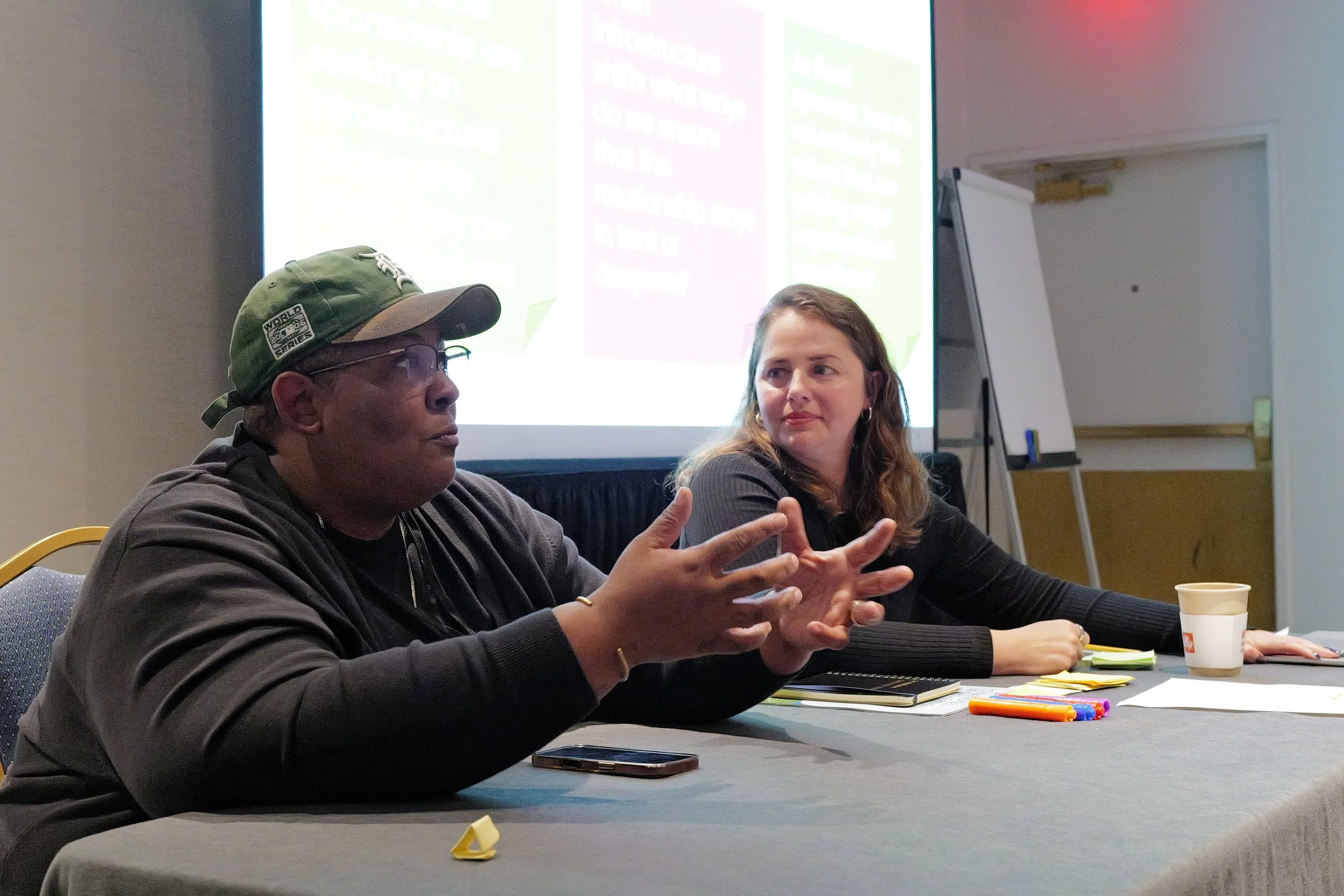
Morgan Willis (left) and Toni Moceri
Willis brought a range of perspectives to this conversation leading a grantmaking fund fiscally sponsored at Proteus Fund currently undergoing leadership transition, and as a former Conference Director and organizational consultant at AMP. They emphasized how relational accountability is part of the infrastructure of movement-aligned fiscal sponsorship that must be resourced and upheld during leadership transitions. Fiscal sponsors are accountable to their sponsored projects, among other stakeholders. Sponsored projects’ primary question during their hosts’ leadership transitions often is: “Are you who you say you are, and will you continue to be who you say you are?” according to Willis. This adds a layer of complexity and accountability.
Willis shared Proteus’ practices that address this complexity with sponsored projects – transparency and candid communications including candidate timelines, fireside chats, feedback channels for project participation that enabled projects to share their perspectives without undue pressure. For Third Wave Fund, the single most vital reassurance was the repeated affirmation from across different Proteus departments and leaders that TWF’s grantmaking mission – to support youth-led, intersectional gender justice activism – would be protected.
“It helped really ground us in understanding that, okay this transition is a big one. But we know that they are still centered in the commitments that they have to us as our fiscal sponsor.” Willis also celebrated both Proteus and AMP for cultivating community among its sponsored projects during their transitions – “the opportunity for organizations and individuals to build relationships with each other and talk about how we navigate this change together.” This turned the tumultuousness and uncertainty of transitions into opportunities for deep trust-building and is the relational infrastructure that leads to stronger organizations and movements. And all of this requires time, leadership, intentionality, and resourcing.
Funders in Partnership with Fiscal Sponsors
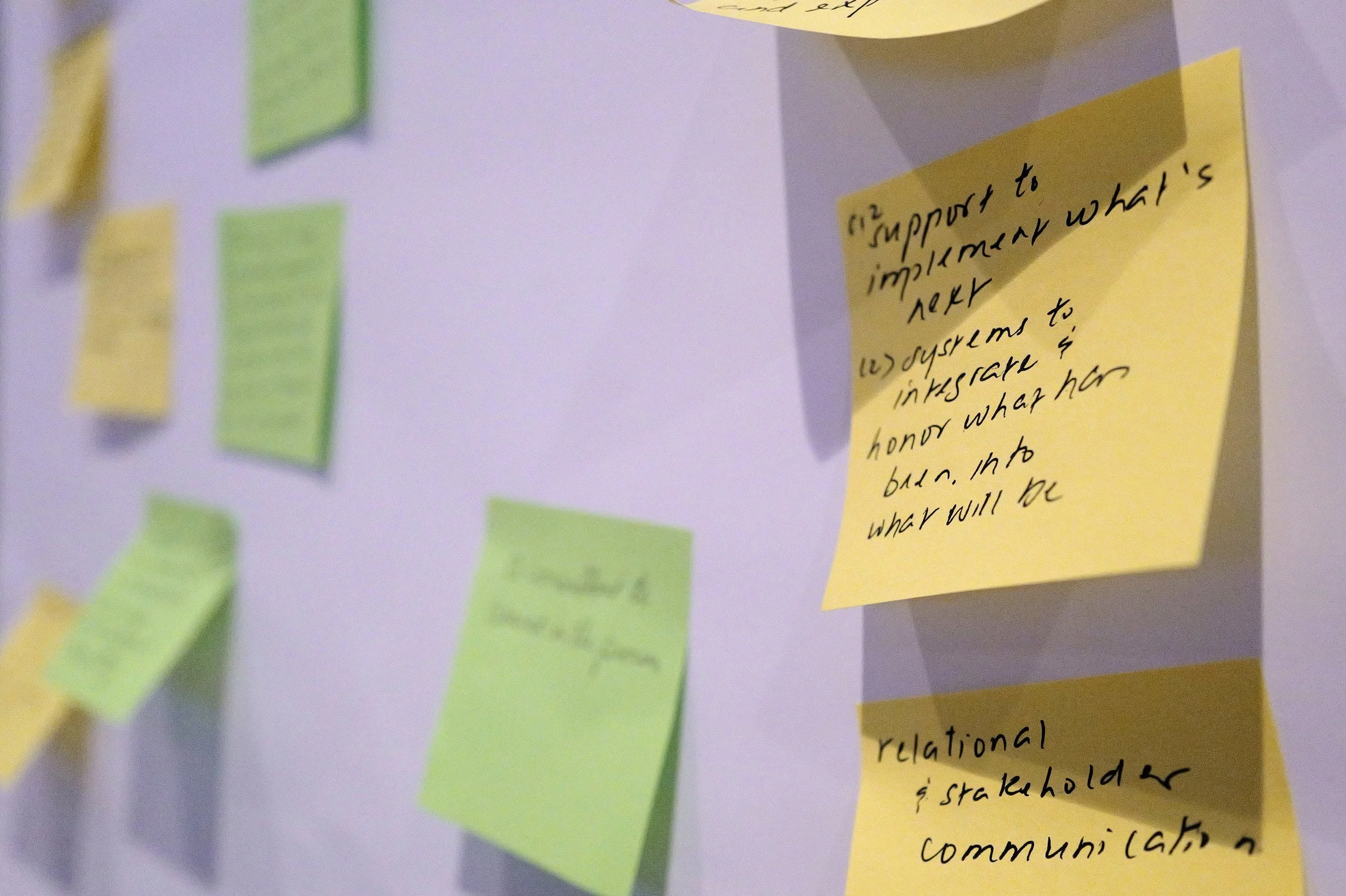
An interactive discussion with participants elicited some critical needs that fiscal sponsors experience during leadership transitions that require special care and resourcing:
Strategic Change Management and Ecosystem Relationships - Fiscal sponsors are complex operational entities. Supporting transitions require dedicated change management consultants who understand muti-entity structures and nonprofit risk assessment. They must also understand ecosystem relationships, and engage in deep and dedicated listening to fully understand and incorporate the diverse perspectives of the ecosystem, including networks of sponsored projects. Additional aspects that require funding are external strategic planning support, operations strengthening especially given the operational backbone role that fiscal sponsors play in their ecosystems, and building systems to integrate and honor organizational and ecosystem history.
Leadership Growth and Succession - Succession planning and leadership coaching across all levels of staff and leadership so that programmatic and operational burdens are distributed. Network liaisons and relationship managers play significant roles supporting sponsored projects during leadership transitions so they need upskilling support. Additionally, incoming leaders might need additional support to fully understand and learn the true operational, relational, and programmatic scale of fiscal sponsorship.
Staff Wellness and Emotional Capacity - Wellness stipends and direct mental health resources are critical for staff and leadership holding complex relationships and diverse priorities during uncertain times. Relationship managers often have to absorb fear, grief and conflict from projects. Additionally, resources for the dedicated time and safe environments required for staff to absorb, explore and process change, and the care and support for staff facilitating those change processes.
Bridging Funding for Handoff Support - Salary funding for leadership overlap, interim assistance and surge staffing. Flexible general operating support can absorb shifting priorities.
Governance and Relational Trust - Support for board accountability structures specifically for fiscal sponsorship governance and bringing it closer to movement accountability. Funding for proactive network and sponsored project communications such as monthly community calls, newsletters, to build ongoing transparency and relational trust.
Want more? Check out our events page for upcoming and past event details and out Perspectives blog for guest viewpoints.